Artificial Intelligence and Data Privacy Concerns in the United States: A Practical Guide for Educators

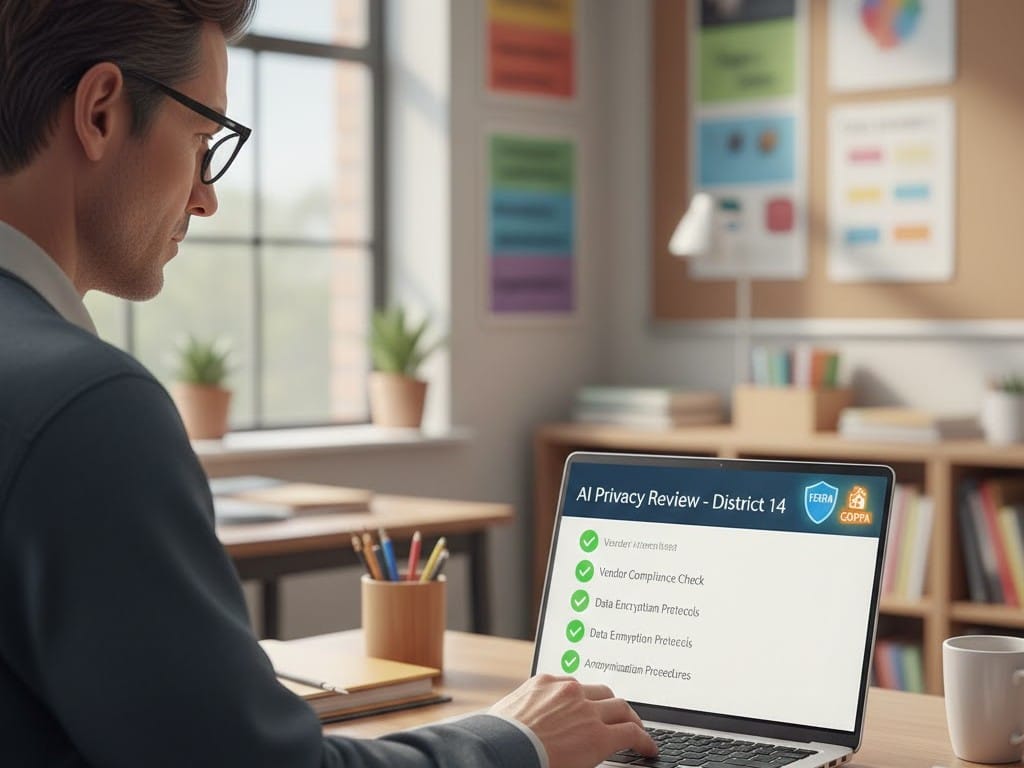
Introduction: Can Schools Use AI Without Compromising Student Privacy?
“Is it legal—and safe—to use this AI tool with my students?” This urgent question is top of mind for U.S. educators as artificial intelligence becomes embedded in grading, tutoring, behavior tracking, and curriculum design. While AI promises personalized learning and administrative efficiency, it also collects, processes, and sometimes stores sensitive student data—raising serious privacy, equity, and legal concerns.
This article provides a clear, actionable roadmap for teachers, administrators, and parents to navigate AI data privacy in U.S. education. Backed by federal guidance, real district policies, and proven best practices, you’ll learn how to harness AI’s benefits without violating FERPA, COPPA, or student trust.

The AI-Privacy Tension: Why It Matters in Schools
AI systems thrive on data—student names, performance histories, behavioral logs, even voice recordings. A 2024 EDUCAUSE report found that 68% of AI-powered edtech tools collect more data than disclosed in their privacy policies. Worse, many free platforms use student interactions to retrain commercial AI models, turning classroom activity into corporate R&D.
The stakes are high:
- Legal risk: FERPA violations can cost districts hundreds of thousands in fines.
- Equity harm: Data leaks or biased profiling can disproportionately affect students of color, English learners, and those with disabilities.
- Erosion of trust: Parents are increasingly wary—42% say they’d opt their child out of AI tools due to privacy concerns (Pew Research, 2025).
Yet, avoiding AI entirely isn’t practical. The solution lies in responsible adoption, guided by law, ethics, and transparency.
Federal and State Privacy Frameworks: What Educators Must Know
Core Federal Laws
1. FERPA (Family Educational Rights and Privacy Act)
FERPA protects students’ “education records”—but AI blurs this definition. Is a chat log with an AI tutor part of a student’s record? The U.S. Department of Education says yes, if it’s maintained by the school or a school-authorized vendor.
Key rule: Schools must have a written agreement (often called a Data Processing Agreement or DPA) with any AI vendor that accesses student data.
2. COPPA (Children’s Online Privacy Protection Act)
Applies to children under 13. Requires verifiable parental consent before collecting personal data (name, email, voice, geolocation). Many AI tools bypass this by requiring school-managed logins—but educators must confirm this with vendors.
Emerging Federal Guidance
The 2023 U.S. Department of Education AI Report established a “privacy-by-design” principle:
“AI systems used in schools must minimize data collection, anonymize where possible, and never use student data for non-educational purposes.”
Additionally, the White House Executive Order on AI (2023) mandates that the Department of Education issue model AI procurement contracts with built-in privacy safeguards—expected by mid-2026.
State-Level Action
- California: Requires third-party privacy audits for all AI tools used in public schools (AB 1522, 2024).
- New York: Mandates parental notification before AI tools collect behavioral or biometric data.
- Texas: Bans AI vendors from selling or sharing student data under the 2025 Student Data Protection Act.
These laws signal a national shift toward enforceable accountability, not just voluntary compliance.
Real Case Scenario: How a Florida School District Addressed AI and Student Data Privacy
In 2024, a public school district in Florida began piloting an AI-powered learning analytics platform designed to help teachers track student progress and personalize instruction. While the tool promised significant instructional benefits, district leaders quickly identified potential data privacy concerns.
Before full deployment, the district conducted a comprehensive privacy review aligned with FERPA and state-level education policies. The review revealed that the AI platform stored student data on third-party servers and used anonymized data to improve its algorithms.
To address these risks, the district implemented several safeguards:
- Required written confirmation that no student data would be sold or shared with external advertisers
- Limited data collection to academic performance only, excluding behavioral or biometric data
- Ensured parental consent procedures were clearly documented
- Established a data retention policy requiring automatic deletion after each academic year
- Trained teachers and administrators on responsible AI usage and data handling practices
As a result, the district successfully integrated AI tools while maintaining compliance with federal privacy regulations and preserving trust among parents, educators, and students.
This case highlights how proactive governance, transparency, and policy alignment allow U.S. schools to benefit from artificial intelligence without compromising student data privacy.
Real-World Incidents and Lessons Learned
Case 1: Facial Recognition Backlash in Lockport City Schools (NY)
In 2023, this district deployed AI-powered cameras to monitor student behavior. After public outcry over surveillance and racial bias concerns—and a $1.2M state investigation—the program was halted. The district now requires community input and bias impact assessments for all AI pilots.
Case 2: Khanmigo’s Privacy Breakthrough
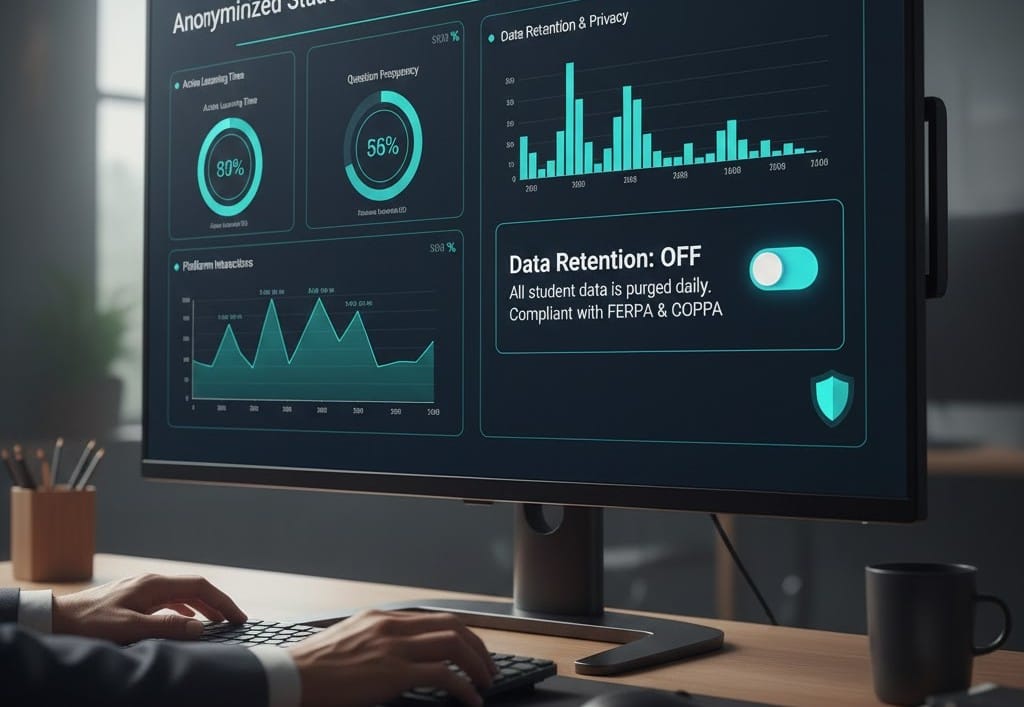
Khan Academy’s AI tutor, Khanmigo, became the first major AI learning tool to achieve FERPA + COPPA + Student Privacy Pledge certification in 2024. It does not store chat histories by default and allows schools to disable data retention. Over 500 U.S. districts now use it safely.
Case 3: Chicago Public Schools’ Vendor Vetting Protocol
CPS developed a 5-point AI Privacy Checklist for all edtech purchases:
- No training on student data
- FERPA-compliant data handling
- Encryption in transit and at rest
- Right to delete data on request
- Annual third-party security audit
Result: 100% compliance in 2024–2025 AI adoptions.
These cases show that proactive policy prevents crisis.
Evaluating AI Tools: A Privacy-Focused Comparison
| Tool | Data Retention? | Trains on Student Data? | FERPA/COPPA Certified? | School Admin Controls |
|---|---|---|---|---|
| Khanmigo | Optional (off by default) | No | Yes | Full control over data settings |
| MagicSchool.ai | No | No | Yes | District SSO, data deletion |
| DreamBox Learning | Yes (for analytics) | No | Yes | Admin dashboard for opt-outs |
| Unknown Free Chatbot | Yes (indefinite) | Yes | No | None |
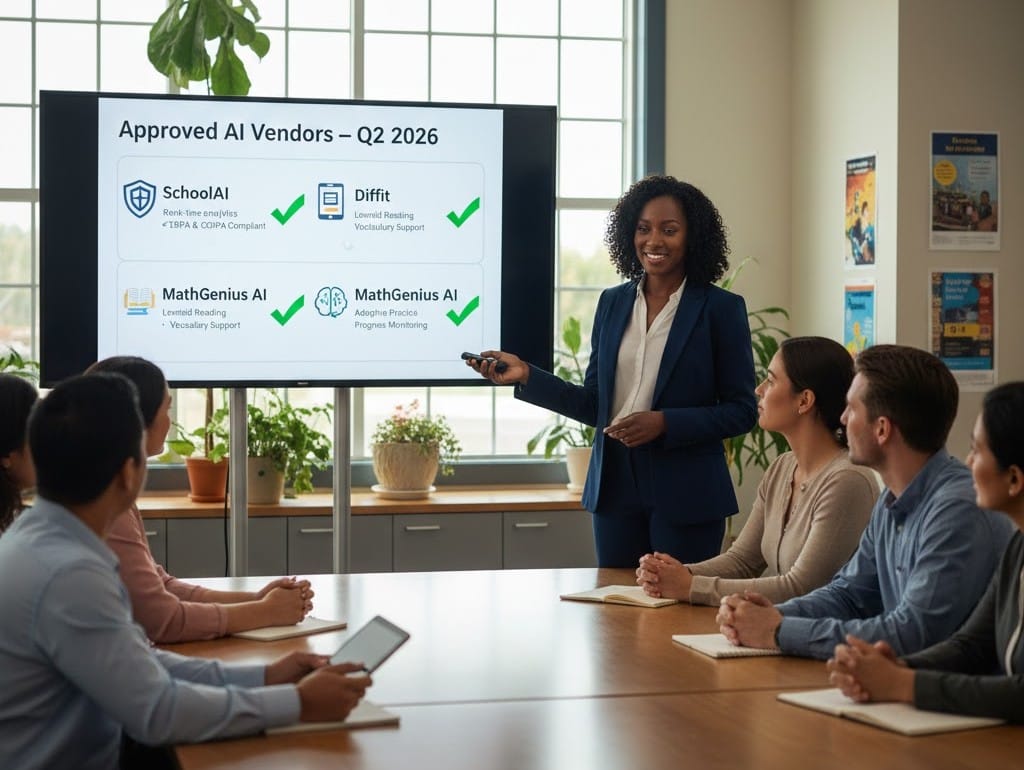
| SchoolAI | School-controlled | No (local model option) | Yes | On-premise deployment available |
Source: Student Privacy Compass (2025); vendor transparency reports
Red flag: If a tool is free and doesn’t clearly state “We do not train on your data,” assume it does.
Practical Strategies for Protecting Student Privacy
For Teachers:
- Never use personal accounts for AI tools with students.
- Ask vendors these 3 questions:
- Do you store or sell student data?
- Do you train your AI models on our inputs?
- Can we delete all data upon request?
- Use anonymized prompts: Instead of “Help John with his algebra,” say “Help a 9th grader struggling with quadratic equations.”
For Administrators:
- Adopt a district AI privacy policy aligned with the Future of Privacy Forum’s Student Guides.
- Require DPAs for all AI vendors—use the U.S. Department of Education’s model contract templates (forthcoming 2026).
- Conduct annual privacy audits: Review which tools have access to student data and whether they’re still needed.
For Parents:
- Request a list of all AI tools used in your child’s classroom.
- Ask about opt-out rights: Under FERPA, students can often decline non-essential AI tools without academic penalty.
- Attend school board meetings where AI procurement is discussed.
Ethical and Equity Considerations Beyond Compliance
Algorithmic Bias in Data Collection
AI systems may collect more data from certain students—e.g., flagging Black students’ speech patterns as “disruptive” in voice analysis tools. A 2024 NSF study found that predictive behavior tools misidentify students with disabilities as “high risk” 3x more often.
Mitigation:
- Audit AI outputs for demographic disparities
- Exclude protected attributes (race, disability status) from input data
- Involve diverse stakeholders in AI pilot design
The “Consent Illusion”
Many schools rely on blanket “acceptable use” forms. But true informed consent requires specific, just-in-time notice—e.g., “Today we’ll use an AI writing tutor that records your prompts. You may use paper instead.”
Overcollection and Function Creep
An AI reading tutor might start by tracking fluency—but later add emotion detection via webcam. Define strict data boundaries upfront and prohibit feature expansion without re-consent.
The Role of AI Literacy in Privacy Protection
Students can’t protect their data if they don’t understand it. The U.S. Department of Education recommends integrating AI and data literacy into K–12 curricula, including:
- How AI systems collect and use data
- The difference between “free” and “paid-with-data” tools
- How to read privacy policies (simplified for grade level)
Example: In Seattle Public Schools, 7th graders complete a unit called “Who Owns Your Data?” where they analyze real AI tool policies and draft “student data bills of rights.”
By 2026, AI literacy—including privacy—will be part of computer science standards in 30+ states.
Future Outlook: What to Expect by 2026–2027
- Federal AI Privacy Rule for Schools: Likely under FERPA modernization, requiring standardized data minimization and breach reporting.
- AI “Privacy Nutrition Labels”: Tools will display icons showing data practices (e.g., “No data retention,” “Bias-audited”).
- Local AI Deployment: More districts will run AI models on school servers or devices, keeping data offline (e.g., Apple’s on-device AI for iPads).
- Parental Data Portals: Families will access dashboards showing which AI tools have accessed their child’s data and when.
The trend is clear: privacy is becoming a non-negotiable feature—not an afterthought.
Conclusion: Building Trust Through Transparent AI Use
AI in education isn’t inherently risky—but unexamined AI is. By anchoring adoption in federal law, centering student rights, and demanding transparency from vendors, U.S. schools can innovate without sacrificing privacy.
Your action plan:
- Audit current AI tools using the 3-question checklist.
- Adopt a district-wide AI privacy policy (use templates from CoSN or Future of Privacy Forum).
- Educate students, staff, and families about data rights.
- Pilot only privacy-by-design tools like Khanmigo or MagicSchool.
When privacy is built in from day one, AI becomes a tool of empowerment—not exposure.
Frequently Asked Questions (FAQ)
1. Is it legal to use ChatGPT with students?
Only if you use school-managed accounts and disable data storage. OpenAI’s free ChatGPT trains on user inputs, violating FERPA. Use ChatGPT Edu (coming 2026) or district-approved alternatives.
2. What’s the difference between FERPA and COPPA?
FERPA protects education records for all students; COPPA requires parental consent for online data collection from children under 13.
3. Can AI tools record student voices or faces?
Only with explicit parental consent and a clear educational purpose. Many states now ban biometric collection in schools without legislative approval.
4. How do I know if an AI tool is FERPA compliant?
Ask for their Data Processing Agreement (DPA) and verify they’re on the Student Privacy Pledge list (privacypledge.org).
5. What should I do if a vendor won’t sign a DPA?
Do not use the tool. FERPA requires a written agreement for any third party accessing student data.
References & Sources
- U.S. Department of Education. (2023). Artificial Intelligence and the Future of Teaching and Learning. https://www.ed.gov/ai
- U.S. Department of Education, FPCO. (2024). Guidance on AI and Student Privacy. https://www2.ed.gov/policy/gen/guid/fpco/ferpa/ai-guidance.pdf
- EDUCAUSE. (2024). AI in Higher Ed: Privacy and Security Report. https://educause.edu/ai-privacy-2024
- Pew Research Center. (2025). Parental Attitudes Toward AI in Schools. https://pewresearch.org/ai-schools-privacy
- National Science Foundation. (2024). Bias in AI-Powered Student Monitoring Systems (Award #2410889).
- Future of Privacy Forum. (2025). Student Privacy Compass: District Guide. https://studentprivacycompass.org
- White House. (2023). Executive Order on the Safe, Secure, and Trustworthy Development and Use of Artificial Intelligence. https://www.whitehouse.gov/ai
- Council of School Supervisors & Administrators (CoSN). (2025). AI Procurement Toolkit for Districts. https://cosn.org/ai-toolkit
- FERPA — U.S. Department of Education
https://www2.ed.gov/policy/gen/guid/fpco/ferpa/index.html - COPPA — FTC
https://www.ftc.gov/legal-library/browse/rules/childrens-online-privacy-protection-rule-coppa - EdWeek Research حول AI في التعليم
https://www.edweek.org/technology