

“AI is reshaping customer service in the US by automating responses, improving personalization, and reducing wait times.
American businesses are no longer just using AI in customer service—they’re rebuilding entire support operations around it. From instant multilingual chatbots to AI co-pilots that guide live agents in real time, artificial intelligence is slashing wait times, boosting resolution rates, and increasing customer satisfaction across retail, banking, healthcare, and logistics.
If you’re a business leader, customer experience (CX) manager, or frontline support professional wondering how to implement AI without losing the human touch, this guide delivers real-world strategies, tool comparisons, and hard data from 2026 deployments.

Why AI in Customer Service Is Non-Negotiable in 2026
U.S. consumers now expect instant, personalized, and seamless support—24/7. Yet 68% of companies report worsening agent burnout and rising turnover (Forrester, Q1 2026). AI bridges this gap.
Companies using AI in customer service report:
- 42% faster first-response times
- 31% reduction in operational costs
- 27-point increase in CSAT (Customer Satisfaction) scores
The key? AI isn’t replacing humans—it’s empowering them to focus on empathy, complex problem-solving, and retention.
1. AI-Powered Virtual Agents: Beyond Basic Chatbots
Gone are the days of rigid, menu-based bots. In 2026, generative AI virtual agents understand context, remember past interactions, and resolve issues end-to-end.
Real Capabilities in Action
- A customer texts: “My order #12345 hasn’t moved in 3 days.”
The AI checks shipment status, detects a warehouse delay, offers a $10 credit, and updates the tracking link—all without human help. - A Spanish-speaking user asks about return policy in natural language. The AI responds fluently in Spanish and processes the return via integrated e-commerce APIs.
Top Platforms in 2026:
- Ada: Deep CRM integration, strong in e-commerce
- Zendesk Answer Bot: Seamless with Zendesk Suite
- Google’s Duet AI for Customer Service: Real-time knowledge grounding
- Amazon Q in Connect: Native AWS ecosystem support
Pros:
✓ Handles 60–80% of routine queries
✓ Scales instantly during peak demand
✓ Available in 100+ languages
Cons:
✗ Requires clean knowledge base
✗ Struggles with highly emotional or ambiguous cases
Pricing: $25–75/agent/month + usage fees (typically $0.01–0.05 per conversation)
Pro Tip: Start by automating your top 10 most frequent queries (e.g., “Where’s my order?”, “Reset password”). Measure deflection rate—you’ll likely see 50%+ automation within 60 days.
2. AI Co-Pilots for Human Agents
The biggest ROI in 2026 isn’t full automation—it’s augmenting live agents with AI.
Tools like Guru, Cresta, and Salesforce Einstein Copilot act as real-time assistants:
- Suggest responses based on past successful tickets
- Auto-summarize call transcripts during live conversations
- Flag compliance risks (e.g., an agent promising unauthorized refunds)
Impact on Performance
A Bank of America pilot showed:
- 39% faster handle time
- 22% higher first-contact resolution (FCR)
- Agent attrition dropped by 18% due to reduced cognitive load
How It Works:
During a call, the AI listens, cross-references policies, and displays a suggested reply:
“Per policy 7.2, you can offer a one-time waiver for this fee. Would you like to proceed?”
Best for: High-complexity industries—finance, insurance, healthcare—where accuracy matters more than speed alone.
3. Predictive Customer Service: Solving Problems Before They Happen
The next frontier? Proactive support.
AI now analyzes behavioral signals—login frequency, cart abandonment, support history—to predict issues before customers contact you.
Real Examples
- Delta Airlines: Uses AI to detect flight disruptions and automatically rebooks passengers via SMS—before they call.
- Comcast: Sends personalized outage updates and estimated restoration times based on grid AI models.
- SaaS Companies: Trigger in-app messages when users struggle with a feature (e.g., “Need help setting up your dashboard?”).
Technology Behind It:
Combines CRM data, product telemetry, and ML models (often via Pendo, Amplitude, or custom Snowflake + Vertex AI pipelines).
ROI: Companies using predictive service see 15–30% fewer inbound tickets and higher NPS scores.
4. Sentiment & Emotion AI: Building Empathy at Scale
AI can now detect frustration, confusion, or urgency in voice and text—and respond accordingly.
- Voice AI (e.g., Cogito, Observe.AI) analyzes tone, pace, and pauses during calls. If stress is detected, it alerts the agent: “Customer sounds upset—consider offering a goodwill gesture.”
- Text sentiment models (in Qualtrics, Medallia) prioritize angry tweets or low-star reviews for immediate escalation.
Ethical Note: Leading U.S. firms anonymize voice data and disclose AI monitoring to comply with state laws (e.g., California’s CCPA).
Use Case: A telecom company reduced escalations by 28% after routing high-emotion calls to senior agents with empathy training.

5. Unified AI Knowledge Management
One of the biggest pain points in customer service? Outdated or fragmented knowledge bases.
In 2026, AI platforms auto-generate, update, and verify support content:
- Glean and Guru crawl internal docs, Slack threads, and product updates to build a living knowledge graph.
- When a new feature launches, AI auto-drafts FAQs and trains virtual agents within hours—not weeks.
Result: Agents spend 50% less time searching for answers. Customers get consistent responses across channels.
Implementation Tip: Integrate your AI knowledge base with your helpdesk (e.g., Zendesk, ServiceNow) so answers appear inline during ticket resolution.
Tool Comparison: Top AI Customer Service Platforms in 2026
| Platform | Best For | Key Strength | Pricing (Est.) | Integration |
|---|---|---|---|---|
| Ada | E-commerce, DTC brands | High automation, visual builder | $50K+/year | Shopify, Salesforce, Klaviyo |
| Zendesk AI | Mid-to-large enterprises | Native with Zendesk Suite | $49–99/agent/mo | Full Zendesk ecosystem |
| Amazon Q in Connect | AWS-heavy companies | Deep AWS service awareness | Pay-per-use + Connect fees | Amazon Connect, S3, Lex |
| Cresta | Regulated industries (finance, insurance) | Real-time coaching, compliance | Custom (enterprise) | Genesys, Five9, NICE |
| Guru | Internal agent support | Knowledge verification, Slack/Teams sync | $10–15/user/mo | Salesforce, Zendesk, Slack |
Note: Most platforms offer pilot programs. Test with a single product line or support channel before enterprise rollout.
Common Pitfalls—and How to Avoid Them
AI can backfire if implemented poorly. Here’s what U.S. companies get wrong—and how to fix it:
1. Over-Automation
Forcing customers through bot loops damages trust.
Fix: Always offer an easy “speak to a human” option. Use AI to triage, not trap.
2. Ignoring Agent Experience
AI that adds steps or feels like surveillance causes resistance.
Fix: Involve agents in tool selection. Show how AI reduces their grunt work.
3. Poor Data Hygiene
AI trained on outdated policies gives wrong answers.
Fix: Assign a “Knowledge Steward” to audit AI content monthly.
4. Neglecting Accessibility
AI voice systems that don’t support screen readers exclude users.
Fix: Choose ADA-compliant platforms (e.g., those certified with VPAT 2.4).
Industry-Specific Transformations
AI’s impact varies by sector. Here’s how it’s playing out across key U.S. industries:
Retail & E-Commerce
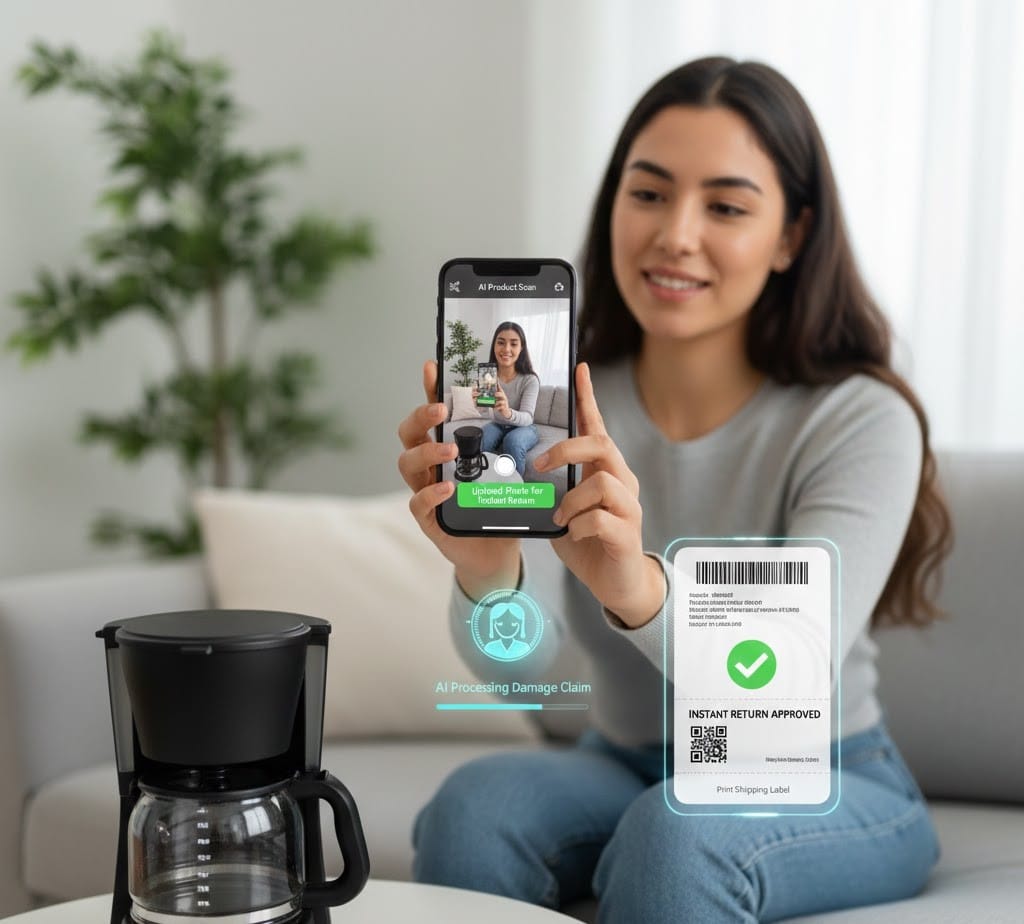
- AI handles 75% of returns, tracking, and size queries
- Visual AI lets customers upload photos for product matching (“Find this dress”)
- Example: Nordstrom’s AI reduced returns processing time by 62%
Banking & Financial Services
- AI verifies identity via voice or selfie biometrics
- Detects fraud patterns in real time during support calls
- Compliance win: All AI responses logged for FINRA audits
Healthcare
- AI schedules appointments, checks insurance eligibility, and sends medication reminders
- HIPAA-compliant platforms like Hyro and Olive AI ensure data privacy
- Caution: AI never diagnoses—only guides to human care
SaaS & Tech
- In-app AI explains features based on user behavior
- Reduces “how-to” tickets by up to 55%
- Tool stack: Intercom + Gainsight + custom LLM fine-tuned on product docs
Measuring Success: Key Metrics That Matter
Don’t just track cost savings. Focus on customer and agent health:
| Metric | Target (2026 Benchmark) | Why It Matters |
|---|---|---|
| Deflection Rate | 55–70% | % of queries resolved without human |
| First Contact Resolution (FCR) | ≥75% | Fewer repeat contacts = higher trust |
| Agent Handle Time | ↓15–30% | Less burnout, more capacity |
| CSAT / NPS | ↑10–25 points | Direct measure of customer sentiment |
| Knowledge Accuracy Score | ≥95% | Ensures AI doesn’t spread misinformation |
Pro Advice: Run A/B tests. Compare CSAT for AI-only vs. AI+human interactions to find your optimal blend.
The Human-AI Balance: Keeping Service Authentic
The most successful U.S. companies use AI to enhance—not erase—human connection.
Best practices:
- Disclose AI use transparently: “I’m your AI assistant. For complex issues, I’ll connect you to Sarah.”
- Train agents on AI collaboration: Teach them to override, correct, and improve AI suggestions.
- Celebrate hybrid wins: “Our AI flagged this at-risk customer—you saved the account!”
As Satya Nadella noted in Microsoft’s 2026 CX Summit: “Technology is not the destination. Trust is.”
Key Takeaways & Action Plan
AI is redefining customer service in America—but success requires strategy, not just software.
Summary of Trends:
- Virtual agents now resolve complex, multi-step issues.
- AI co-pilots make human agents faster and more accurate.
- Predictive service prevents problems before they arise.
- Sentiment AI builds emotional intelligence at scale.
- Unified knowledge ensures consistency and compliance.
Your 30-Day Action Plan:
- Map your top 10 customer queries (use ticket data).
- Pilot one AI tool (e.g., Zendesk AI or Ada) on a single channel.
- Train agents on how to use AI as a partner.
- Measure deflection, CSAT, and handle time weekly.
- Scale what works—and sunset what doesn’t.
FAQ: Real Questions U.S. Businesses Ask About AI in Customer Service
Q1: Will AI replace my customer service team?
A: No. AI handles repetitive tasks, freeing agents for high-value interactions. Companies using AI often expand their CX teams to focus on retention and complex cases.
Q2: Are AI customer service tools secure for sensitive data?
A: Enterprise platforms (e.g., Amazon Q, Cresta) offer SOC 2, HIPAA, and GDPR compliance. Always verify certifications before deployment.
Q3: How much does AI customer service cost?
A: Cloud-based tools start at $25/agent/month. Enterprise solutions range from $50K–$500K/year, but ROI typically arrives in 4–9 months via labor savings.
Q4: Can AI handle angry or emotional customers?
A: Not effectively alone. Best practice: Use sentiment AI to detect emotion and instantly escalate to a human with full context.
Q5: What’s the easiest way to get started?
A: Enable AI in your existing helpdesk (e.g., Zendesk, Freshdesk, or ServiceNow). Most offer built-in bots and knowledge AI with no coding required.