The AI Classroom: How American Tech Companies Are Reshaping Education in 2026


Introduction: The AI Revolution in American Classrooms
How can AI help my students learn better while saving me precious instructional time? American technology companies are answering this urgent educator question by developing AI systems that personalize learning pathways, automate administrative tasks, and provide unprecedented insights into student progress. This exclusive analysis explores how U.S.-based AI innovations are fundamentally transforming teaching, learning, and school administration—providing educators with actionable strategies to harness these tools responsibly and effectively in 2026.
The U.S. Department of Education’s 2024 National Educational Technology Plan explicitly calls for “designing education technology that is equitable, accessible, and accelerates learning.” American tech companies have responded with unprecedented investment, with the National Science Foundation reporting a 300% increase in AI education research funding since 2022. This article provides educators, administrators, and policymakers with a comprehensive roadmap for navigating this rapidly evolving landscape.

How AI Developments Are Shaping Educational Technology
The Shift from One-Size-Fits-All to Personalized Learning
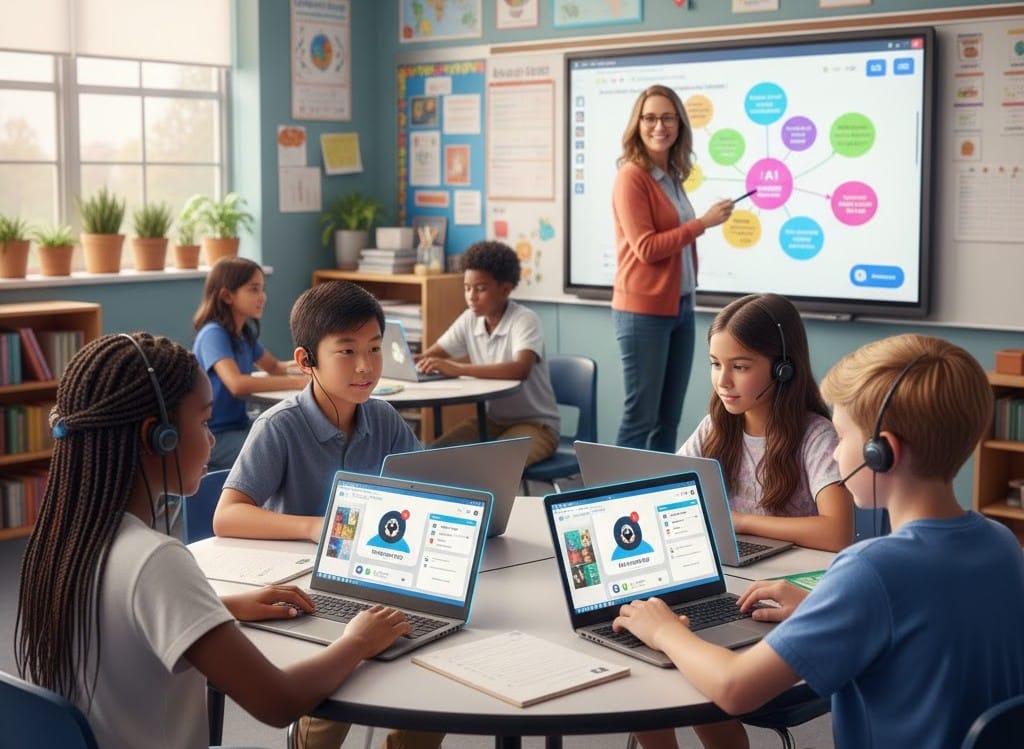
American tech giants and startups are leveraging machine learning to create adaptive learning environments that respond to individual student needs in real-time. Unlike traditional educational software, today’s AI platforms analyze multiple data points—response patterns, engagement metrics, and knowledge gaps—to adjust content difficulty, presentation style, and pacing.
Key developments include:
- Natural Language Processing (NLP) systems that provide instant, personalized feedback on writing assignments
- Computer vision applications that detect student confusion or disengagement during digital lessons
- Predictive analytics that identify at-risk students weeks before traditional methods
The 2025 ISTE Standards for AI in Education emphasize that these systems must be “transparent, equitable, and teacher-guided.” Successful implementations maintain educator oversight while leveraging AI’s scalability.
Transforming Administrative Efficiency
School administrators are benefiting from AI-powered systems that streamline operations, from scheduling to compliance reporting. Districts like Fairfax County Public Schools have reported reducing administrative workload by 40% using AI-driven platforms.
Administrative applications now include:
- Automated IEP (Individualized Education Program) documentation assistance
- Smart scheduling that optimizes teacher assignments and classroom usage
- Predictive maintenance for school infrastructure and technology assets
Real-World Implementation: Case Studies from American Schools
Success Story: Chicago Public Schools’ Literacy Initiative
In 2024, Chicago Public Schools partnered with a U.S. ed-tech company to implement an AI-powered literacy platform across 50 elementary schools. The system provided:
- Real-time pronunciation correction during reading exercises
- Vocabulary adaptation based on individual student progress
- Automated progress reports aligned with state standards
Measurable outcomes after one year:
- 28% improvement in reading fluency scores for participating students
- 15 hours per week recovered for teachers previously spent on manual assessment
- 92% teacher satisfaction with the platform’s integration
Case Study: Rural District Bridging the Achievement Gap
A consortium of rural districts in Appalachia implemented an AI tutoring system to address STEM teacher shortages. The platform, developed by Carnegie Mellon University researchers, provided:
- 24/7 homework assistance in mathematics and science
- Culturally responsive content adjustments for regional contexts
- Parent dashboards showing student progress and suggested support activities
Results documented in NSF-funded research:
- Mathematics proficiency increased from 42% to 67% over two years
- College STEM enrollment from participating schools rose by 18%
- Implementation cost: $47 per student annually
AI Tools for American Classrooms: A Comparative Analysis
| Tool Category | Primary Functions | Best For | Cost Range | Data Privacy Compliance |
|---|---|---|---|---|
| Adaptive Learning Platforms (e.g., DreamBox, Khanmigo) | Personalizes math/reading pathways, provides hints, assesses mastery | Elementary-middle school foundational skills | $30-$100/student/year | FERPA, COPPA, State-specific |
| AI Writing Assistants (e.g., Grammarly Edu, Quill) | Real-time grammar feedback, style suggestions, plagiarism detection | Middle school through college writing development | $10-$40/student/year | FERPA-certified, encrypted data |
| Administrative Automation (e.g., PowerSchool AI, Scribbles) | Automates scheduling, reporting, IEP documentation | School and district administrators | $5-$20/student/year | HIPAA, FERPA, SOC 2 Type II |
| Conversational AI Tutors (e.g., Quizlet Q-Chat, Yippity) | Answers student questions, provides explanations, creates practice questions | Homework help, test preparation | Free-$25/student/year | COPPA-compliant options available |
| Learning Analytics Dashboards (e.g., GoGuardian, Hāpara) | Identifies at-risk students, monitors engagement, suggests interventions | Teachers needing actionable insights | $15-$50/student/year | State data privacy laws compliant |
Navigating Challenges and Ethical Considerations
Data Privacy and Security in AI-Powered Education
The Family Educational Rights and Privacy Act (FERPA) and Children’s Online Privacy Protection Act (COPPA) establish critical boundaries for educational AI. Responsible implementation requires:
Best practices for compliance:
- Implementing strict data anonymization before AI processing
- Ensuring all vendors provide transparent data usage policies
- Creating district-level data governance committees
- Providing annual parent notifications about AI tools in use
The U.S. Department of Education’s 2025 Guidance on AI and Student Privacy emphasizes that “AI should enhance educational practice without compromising student data rights.”
Addressing Algorithmic Bias and Equity Concerns
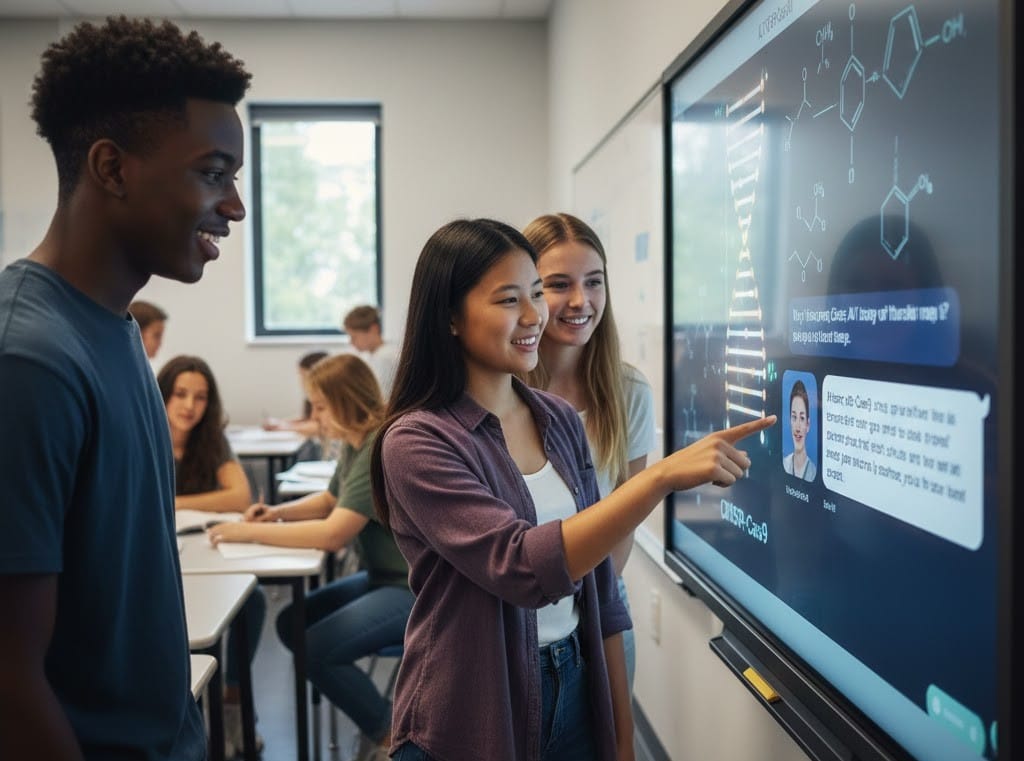
Research from Stanford University’s Graduate School of Education reveals that AI systems can perpetuate existing educational inequities if not carefully designed and monitored.
Mitigation strategies include:
- Regular bias audits of AI recommendations and outcomes
- Diverse training data representing all student demographics
- Teacher override capabilities for all AI suggestions
- Transparency about system limitations to all stakeholders
Practical Implementation Barriers
Cost remains a significant challenge, with comprehensive AI implementation costing $50-150 per student annually. The 2025 Federal AI Literacy Act includes grant funding for qualifying districts, but disparities persist.
Teacher training gaps present another hurdle. A 2024 EdSurge survey found that 68% of teachers feel unprepared to effectively use AI tools. Districts like Miami-Dade County have responded with mandatory 15-hour AI proficiency certification for all instructional staff.
Policy Landscape: Federal and State Guidelines
Federal Initiatives Shaping AI in Education
The Biden administration’s Executive Order on Safe, Secure, and Trustworthy Artificial Intelligence (2023) established foundational principles for educational AI, emphasizing safety, equity, and innovation protection. Subsequent legislation includes:
- AI Literacy Act (2025): Provides $500M annually for teacher training and curriculum development
- STEM Opportunities Act (2024): Allocates funding specifically for AI education in underserved communities
- Department of Education’s Office of Educational Technology guidelines on responsible AI implementation
State-Level Mandates and Frameworks
California’s Artificial Intelligence in Education Framework (2024) serves as a model for state policies, requiring:
- Annual AI tool audits for bias and effectiveness
- Parental opt-out provisions for non-essential AI systems
- Digital literacy curricula that include AI understanding
- Vendor compliance with state student data privacy laws
Actionable Implementation Roadmap for 2026
For Teachers: Getting Started with AI
- Begin with one focused application: Choose a single area (grading, differentiation, or feedback) for initial AI implementation
- Utilize free resources first: Platforms like Khan Academy’s Khanmigo or Google’s Gemini Education offer no-cost entry points
- Join professional learning communities: ISTE’s AI Explorations community connects educators implementing similar tools
- Develop clear classroom protocols: Establish when and how AI tools should be used by students
- Maintain critical oversight: Regularly review AI recommendations for accuracy and appropriateness
For Administrators: Strategic AI Integration
- Conduct a needs assessment: Identify 2-3 priority areas where AI could have maximum impact
- Create an AI task force: Include teachers, IT staff, parents, and students in planning
- Develop procurement guidelines: Establish standards for vendor transparency, data security, and efficacy evidence
- Phase implementation: Start with pilot programs before district-wide adoption
- Measure and adjust: Establish clear metrics for success and regular evaluation cycles
For District Leaders: Policy and Infrastructure
- Adopt an AI governance framework: The Consortium for School Networking (CoSN) provides comprehensive templates
- Invest in infrastructure: Ensure adequate bandwidth and device access for AI applications
- Negotiate district-wide licenses: Consolidate purchasing for better pricing and integration
- Develop community transparency reports: Regularly communicate AI usage, benefits, and safeguards to families
- Plan for sustainability: Include AI tool refresh cycles in long-term technology budgets
The Future of AI in American Education
Emerging Trends for 2026-2027
Multimodal AI systems that combine speech, text, and visual processing will create more immersive learning experiences. Early research from MIT’s Open Learning initiative shows 40% greater concept retention with multimodal approaches.
AI-powered professional development will personalize teacher training based on classroom observations and student outcomes. The New Teacher Center is piloting systems that suggest targeted strategies for individual educators.
Generative AI for curriculum creation will help teachers develop culturally responsive materials efficiently. Tools like Diffit and Curipod are already reducing planning time by 60% in pilot districts.
Long-Term Implications
The National Academy of Education’s 2030 Forecast: AI and the Future of Learning predicts that AI will fundamentally shift teacher roles toward mentorship and complex problem-solving while automating routine tasks. The report emphasizes that “human judgment, empathy, and ethical reasoning will become the premium skills in AI-enhanced classrooms.”

Conclusion: Balancing Innovation with Responsibility
American technology companies are delivering unprecedented tools to enhance educational outcomes, but successful implementation requires thoughtful strategy, continuous evaluation, and unwavering commitment to equity. The most effective schools in 2026 will be those that leverage AI’s analytical power while strengthening human connections.
Immediate next steps for educators:
- Complete a free AI literacy course (ISTE or Code.org offer excellent options)
- Experiment with one AI tool this month during planning or assessment
- Join a conversation about AI ethics at your school or district
- Document and share your experiences to build collective knowledge
The AI revolution in education isn’t coming—it’s here. By approaching these tools with curiosity, critical thinking, and care for our students, American educators can harness AI to create more effective, equitable, and inspiring learning environments.
Frequently Asked Questions (FAQ)
Q: How can I ensure AI tools protect my students’ data privacy?
A: Always verify FERPA and COPPA compliance, review vendor privacy policies thoroughly, implement strong data anonymization, and provide clear opt-out options for families. The Student Data Privacy Consortium maintains a registry of vetted tools.
Q: What’s the actual time investment for teachers to learn AI systems?
A: Most classroom-ready AI tools require 2-5 hours of initial training, with proficiency developing over 3-4 weeks of regular use. Districts with structured onboarding programs report 90% teacher competency within one month.
Q: Are there AI tools that work effectively for students with disabilities?
A: Yes, tools like Microsoft’s Immersive Reader and Google’s Read Along use AI to provide text-to-speech, comprehension support, and personalized accommodations. The National Center for Learning Disabilities offers evaluations of accessibility-focused AI tools.
Q: How do I address parental concerns about AI in the classroom?
A: Host informational sessions demonstrating tools, provide clear written explanations of benefits and safeguards, emphasize teacher oversight, and share research on positive outcomes. The National PTA offers conversation guides for families.
Q: What metrics should we use to evaluate AI tool effectiveness?
A: Measure student growth (pre/post assessments), engagement metrics (time on task, participation), teacher time savings, and equity of outcomes across student subgroups. The What Works Clearinghouse provides evaluation frameworks.
References & Sources
- U.S. Department of Education. (2024). 2024 National Educational Technology Plan. Office of Educational Technology.
Retrieved from: https://tech.ed.gov/netp/
Provides federal guidance on equitable and effective use of technology, including AI, in K-12 education. - National Science Foundation. (2025). AI Research in Education: Annual Report (NSF 25-201).
Retrieved from: https://www.nsf.gov/publications/pub_summ.jsp?ods_key=nsf25201
Details trends, funding, and outcomes of AI-focused educational research in U.S. schools. - International Society for Technology in Education (ISTE). (2025). Standards for AI in Education. ISTE Publications.
Retrieved from: https://www.iste.org/standards
Defines best practices for integrating AI in classrooms, emphasizing transparency, ethics, and pedagogy. - Stanford University Graduate School of Education. (2024). Algorithmic Bias in Educational AI: A Comprehensive Study. Stanford CEPA Working Paper.
Retrieved from: https://cepa.stanford.edu/working-papers/algorithmic-bias-ai
Analyzes risks of algorithmic bias in AI-powered learning systems and proposes mitigation strategies. - Consortium for School Networking (CoSN). (2025). AI Governance Framework for K-12 Schools. CoSN Report.
Retrieved from: https://www.cosn.org/reports/ai-governance-framework
Provides a model policy framework for district-wide AI adoption, compliance, and ethical oversight. - U.S. Department of Education. (2025). Guidance on AI and Student Privacy. Student Privacy Policy Office.
Retrieved from: https://studentprivacy.ed.gov/resources/guidance-ai-and-student-privacy
Outlines FERPA/COPPA-compliant practices for AI tools in educational settings. - EdSurge Research. (2024). Educator Preparedness for AI Integration: National Survey Results.
Retrieved from: https://www.edsurge.com/research/educator-preparedness-ai
Presents survey data on teacher readiness, training gaps, and perceptions of AI in U.S. classrooms. - National Academy of Education (NAEd). (2025). 2030 Forecast: AI and the Future of Learning. NAEd Publications.
Retrieved from: https://naeducation.org/publications/2030-ai-forecast
Predicts long-term impacts of AI on teaching roles, student learning outcomes, and educational equity. - What Works Clearinghouse. (2025). Evaluating Educational Technology Interventions. Institute of Education Sciences.
Retrieved from: https://ies.ed.gov/ncee/wwc/
Offers evidence-based methods to assess effectiveness of AI and other ed-tech tools. - Student Data Privacy Consortium (SDPC). (2025). Vendor Compliance Registry.
Retrieved from: https://privacy.a4l.org/
Lists vetted educational technology vendors that comply with student privacy regulations.