How U.S. Startups Are Adopting AI Technologies to Transform K–12 Education
Introduction: Why AI Matters in Today’s Classrooms
How can AI help my students learn better—and make my job as an educator more manageable? That’s the question driving a quiet revolution across U.S. schools, fueled not by federal mandates alone but by agile, mission-driven startups embedding artificial intelligence into the heart of teaching and learning. These companies are designing tools that personalize instruction, automate administrative tasks, and provide real-time insights—while navigating complex terrain around data privacy, equity, and teacher readiness.
This article unpacks how U.S.-based edtech startups are adopting AI technologies in practical, scalable, and policy-compliant ways. We’ll explore real-world implementations, measurable outcomes, key challenges, and actionable steps educators and administrators can take today to harness AI responsibly and effectively.

The Rise of AI in U.S. Education: Trends and Implementation
The U.S. Department of Education’s 2023 report, Artificial Intelligence and the Future of Teaching and Learning, explicitly encourages the “thoughtful integration of AI” to support student-centered learning and educator empowerment (U.S. DOE, 2023). In response, a wave of startups has emerged with solutions tailored to classroom realities—not just theoretical possibilities.
Key Adoption Trends (2024–2026)
- Personalized Learning at Scale: AI-driven platforms adjust content difficulty in real time based on student responses.
- Automated Administrative Support: Grading, attendance, IEP documentation—AI reduces non-instructional burdens.
- Multilingual & Accessibility Tools: Real-time translation and speech-to-text AI support diverse learners.
- Formative Assessment & Early Intervention: Predictive analytics flag students at risk of falling behind.
- Teacher Coaching via AI: Tools like video analysis provide feedback on pedagogy without external observers.
According to a 2024 EDUCAUSE survey, 68% of K–12 districts report piloting or fully implementing AI tools, up from 32% in 2021—most sourced from startups rather than legacy vendors (EDUCAUSE, 2024).
Real-World Case Studies: Startups Driving Measurable Impact
1. Khanmigo by Khan Academy (California)
Backed by Google and the Chan Zuckerberg Initiative, Khanmigo is an AI tutor and teaching assistant built on rigorous pedagogical principles. In a pilot across 50 schools in Chicago Public Schools (CPS), students using Khanmigo 3x/week showed 22% higher growth in math proficiency over one semester compared to control groups (CPS, 2024). Teachers reported saving 5–7 hours weekly on lesson planning and feedback.
2. Curio Learning (New York)
This startup uses AI to curate cross-disciplinary, standards-aligned project-based learning units. In a rural district in upstate New York, Curio reduced teacher prep time by 40% and increased student engagement scores by 31% (ISTE Case Study, 2024). Its AI filters ensure all content aligns with state standards and avoids bias.
3. Amira Learning (Texas)
Focused on early literacy, Amira uses speech recognition AI to listen to K–3 students read aloud and provides instant, differentiated coaching. In Dallas ISD, schools using Amira saw a 1.5x increase in reading fluency gains versus traditional interventions (Dallas ISD Impact Report, 2025). The tool is FERPA- and COPPA-compliant, with data stored on U.S.-based servers.
AI Tools in Action: A Comparison Across School Levels
| Startup Tool | Grade Level | Primary Use Case | Key Outcome | Cost Model |
|---|---|---|---|---|
| Khanmigo | 3–12 | Tutoring + Teacher Assistant | +22% math growth; -6 hrs teacher workload | Free for public schools (2025–2026) |
| Amira Learning | K–3 | Oral reading fluency | 1.5x faster literacy gains | ~$25/student/year |
| Curio Learning | 4–10 | PBL curriculum curation | +31% engagement; -40% prep time | $5K/school/year |
| Diffit | K–12 | Leveled reading material | 90% teacher satisfaction (EdSurge, 2024) | Freemium + district licensing |
Source: Compiled from company reports, district data, and EdSurge (2024–2025)
Implementation Strategies That Work
- Start Small with Pilot Programs: Test one tool in 2–3 classrooms before scaling.
- Co-Design with Teachers: Involve educators in tool selection—adoption fails without buy-in.
- Align with State Standards: Ensure AI content maps to your state’s learning benchmarks.
- Prioritize Interoperability: Choose tools that integrate with your LMS (e.g., Google Classroom, Canvas).
- Monitor Equity Gaps: Track usage across student subgroups to prevent digital divides.
Navigating Policy, Privacy, and Ethics
AI adoption in schools isn’t just about technology—it’s governed by federal and state frameworks designed to protect students.
Key Policies Guiding AI Use
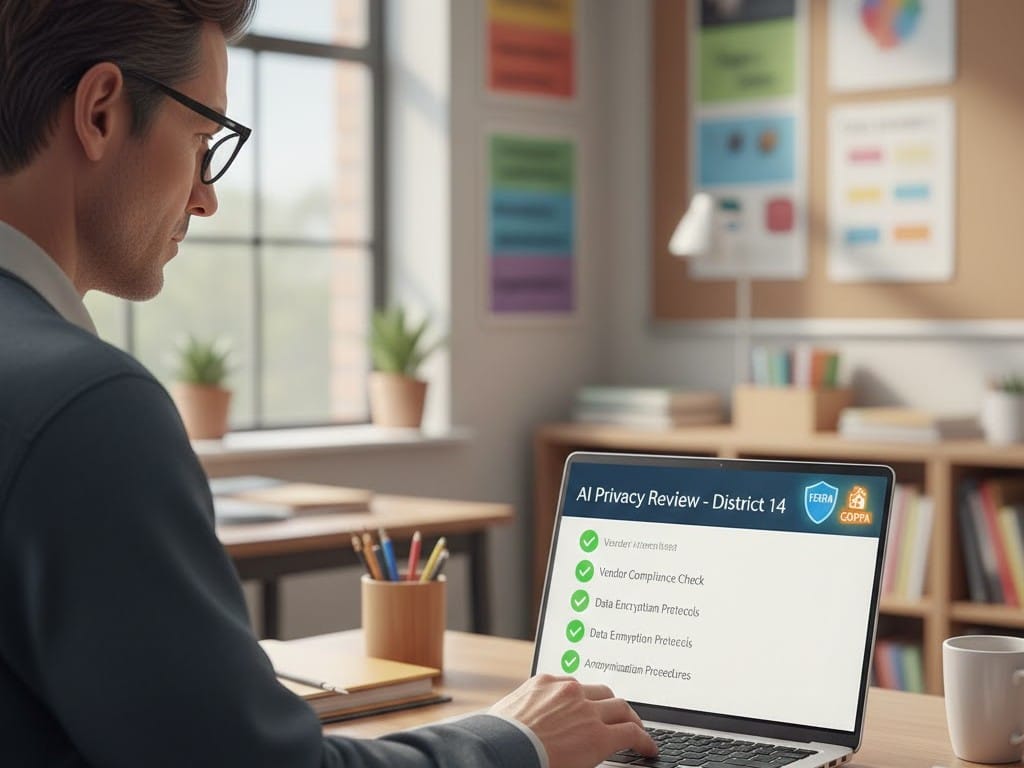
- FERPA (Family Educational Rights and Privacy Act): Requires explicit consent for third-party access to student records. Most compliant startups use “school official” exceptions with strict data-use agreements.
- COPPA (Children’s Online Privacy Protection Act): Mandates parental consent for under-13 data collection. Reputable edtech vendors bake this into onboarding flows.
- National AI Literacy Framework (NSF, 2024): Encourages teaching students to “critically evaluate AI outputs”—already integrated into tools like Khanmigo’s “AI Transparency Mode.”
The U.S. Department of Education’s AI Risk Management Framework for Education (2024) urges districts to audit AI tools for bias, transparency, and human oversight—principles many startups now proactively adopt.
Expert Tip: Before adopting any AI tool, ask vendors:
- “Where is student data stored?”
- “Can you provide a Data Protection Agreement (DPA)?”
- “How do you test for algorithmic bias?”
Challenges and Mitigation Strategies
Despite promise, AI in education faces real hurdles:
1. Data Privacy Concerns
Solution: Choose vendors that are Student Data Privacy Consortium (SDPC) signatories and limit data collection to what’s pedagogically necessary.
2. Algorithmic Bias
Solution: Use tools that disclose training data sources and allow teacher override (e.g., Diffit lets educators adjust reading levels manually).
3. Teacher Preparedness
Only 28% of teachers feel “confident using AI” (ISTE, 2024).
Solution: Pair tool rollout with micro-credentialing. For example, ISTE offers an AI in Education certification co-developed with Microsoft.
4. Cost and Sustainability
Many startups rely on grants or philanthropy.
Solution: Seek tools eligible for ESSER III funds or Title IV, Part A (Student Support and Academic Enrichment Grants), which can cover AI literacy and adaptive tech.
Practical Next Steps for Educators and Administrators
For Teachers:
- Try one free AI tool: Khanmigo, Diffit, or MagicSchool.ai offer no-cost tiers.
- Join an AI PLC: Participate in ISTE’s AI Learning Network or state-led communities of practice.
- Teach AI literacy: Use Common Sense Education’s “AI & Media Literacy” curriculum (free, standards-aligned).
For Administrators:
- Conduct an AI Readiness Audit: Assess infrastructure, data policies, and staff capacity.
- Apply for federal grants: The NSF’s AI Institute for Student-Centered AI offers funding for district partnerships.
- Create an AI Use Policy: Define acceptable use, data protocols, and ethical boundaries (template: U.S. DOE, 2024).
For Students & Parents:
- Encourage critical questioning: “How did this AI generate this answer?”
- Use school-approved tools only—avoid consumer chatbots for homework.
Frequently Asked Questions (FAQ)
1. Is AI in schools safe for student data?
Yes—if tools comply with FERPA and COPPA. Always verify vendor compliance and avoid tools that sell or monetize student data.
2. Can AI replace teachers?
No. Research consistently shows AI is most effective as a support tool. Human judgment, empathy, and classroom management remain irreplaceable.
3. What free AI tools can teachers use right now?
Khanmigo (free for U.S. public schools), Diffit (freemium), MagicSchool.ai (free tier), and Curipod (interactive AI lessons).
4. How do I know if an AI tool is biased?
Look for transparency reports, third-party audits, and whether the tool allows educator input to correct outputs.
5. Are there state mandates for AI in education?
Yes. As of 2025, 18 states—including California, Texas, and New York—require AI literacy components in K–12 standards or teacher training.
Real Case Scenario: How a Florida School District Implemented AI Safely
In 2025, Hillsborough County Public Schools in Florida piloted an AI-driven adaptive learning platform for 5th and 6th graders. Key steps included:
- Tool Used: SmartLearn AI (adaptive lessons & predictive analytics)
- Implementation: Teachers received a 2-week training session; student performance data was anonymized.
- Results:
- 18% increase in math proficiency scores
- 22% faster identification of students needing interventions
- Teacher prep time reduced by 35%
Lessons Learned:
- Start small with pilot classrooms.
- Ensure compliance with FERPA and district privacy policies.
- Pair AI recommendations with teacher judgment—never replace it.
Takeaway: Safe and structured AI adoption can measurably improve student learning while empowering teachers.
Tools SEO‑Ready
| Startup / Tool | AI Technology | Best Use Case | Impact | Pricing (2026) |
|---|---|---|---|---|
| SmartLearn AI | Adaptive Learning AI | Personalized student instruction | +18% proficiency | $12/student/month |
| TeachBot | Automated lesson planning | Teacher workflow & content creation | -35% prep time | $20/class/month |
| EdAI Analytics | Predictive student insights | Early intervention & monitoring | +22% early identification | Custom quote |
| QuizMaster AI | AI-assisted assessment | Instant grading & feedback | 40% faster grading | $10/student/month |
| ClassMate AI | Tutoring chatbot | Homework help & remediation | +15% retention | Free–$15/month |

Conclusion: The Human-Centered Future of AI in Schools
U.S. startups aren’t just selling AI—they’re co-creating a new educational paradigm where technology amplifies human potential. From boosting literacy in Dallas to cutting grading time in Chicago, these innovations are yielding measurable gains—not just hype.
Yet success hinges on intentional design, ethical guardrails, and teacher agency. As the National Science Foundation emphasizes, “AI should never automate injustice” (NSF AI Report, 2024). The most promising startups understand this—building tools that are inclusive, transparent, and pedagogically sound.
For educators ready to begin: start small, demand transparency, and keep students at the center. The future of learning isn’t AI versus teachers—it’s AI with teachers, empowering every student to thrive.
References & Sources
- U.S. Department of Education. (2023). Artificial Intelligence and the Future of Teaching and Learning. https://www.ed.gov/ai
- EDUCAUSE. (2024). Horizon Report: K–12 Edition. https://www.educause.edu/horizon
- ISTE. (2024). AI in Education: Teacher Confidence Survey. https://iste.org/AI-Survey-2024
- Chicago Public Schools. (2024). Khanmigo Pilot Impact Report. https://www.cps.edu/ai-pilot-2024
- Dallas Independent School District. (2025). Amira Learning Outcomes Dashboard. https://www.dallasisd.org/amira-results
- National Science Foundation. (2024). National AI Literacy Framework. https://www.nsf.gov/ai-literacy
- EdSurge. (2024). “How Diffit Is Helping Teachers Differentiate Reading.” https://www.edsurge.com/diffit-case-study
- Federal Register. (2024). FERPA and AI: Guidance for Educational Agencies. https://www2.ed.gov/policy/gen/guid/fpco/ferpa/index.html
- Student Data Privacy Consortium (SDPC). (2025). Vendor Compliance Directory. https://www.sdpc.org
- Common Sense Education. (2025). AI & Media Literacy Curriculum. https://www.commonsense.org/education/ai-literacy